Language in Bangkok: what to say, and when English works
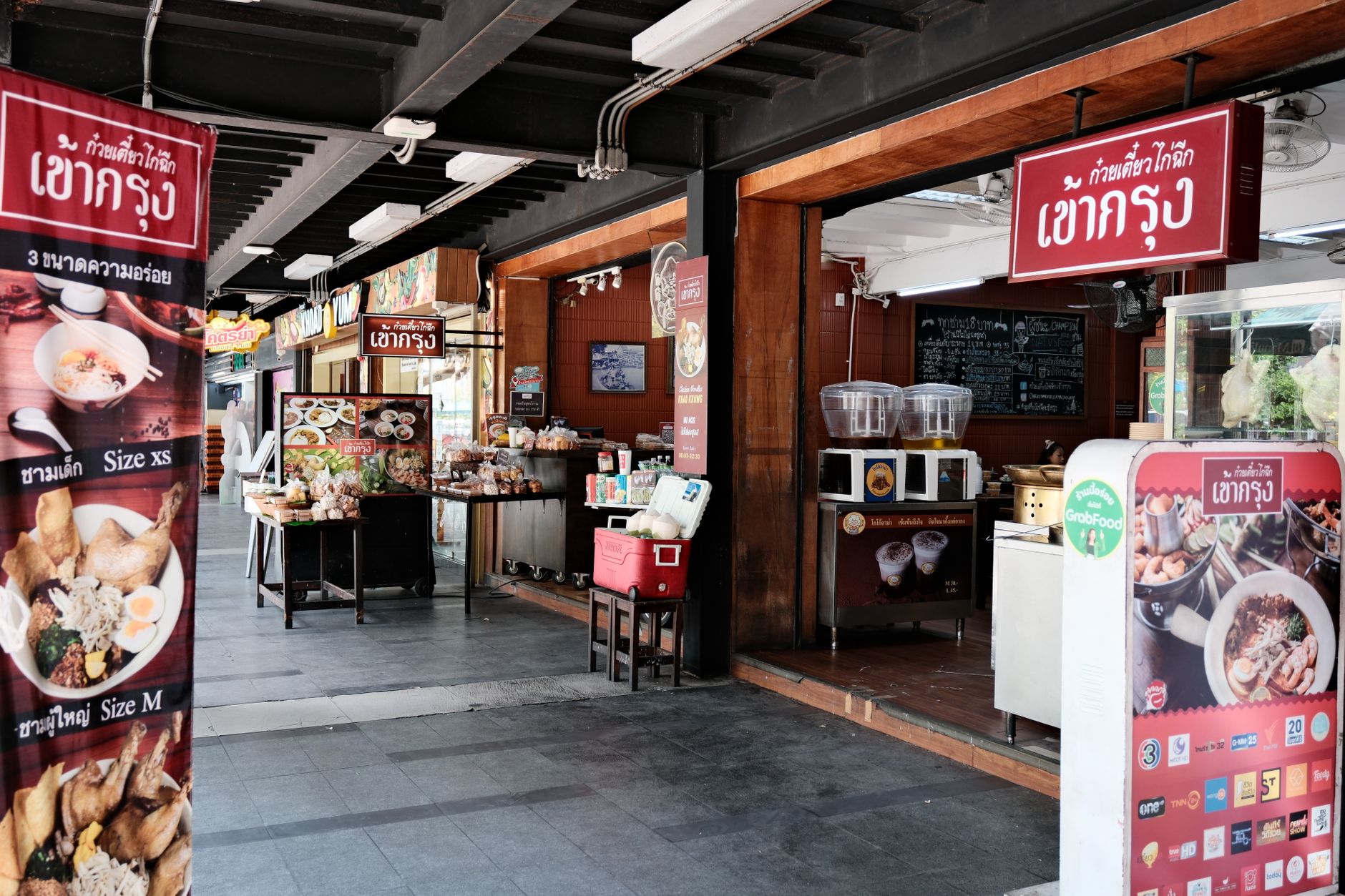 Menu written in Thai script at a street food stall
The 12 Thai phrases that carry a two-week trip, plus honest coverage of where English does and doesn’t get you through.
Where English works and where it doesn’t
English coverage in Bangkok follows tourist density almost exactly. Sukhumvit between Nana and Ekkamai, all of Silom and Sathorn, Siam, Ratchathewi, Khao San, the international hospitals, every mall, and the BTS/MRT staff windows all operate in functional English. Hotel receptionists at anything three-star and up speak business English. Chain restaurant menus have English translations. You can spend a week in these areas without learning a Thai word and be broadly fine.
Where English falls off a cliff: taxi drivers (about 40% speak enough for a hotel address, 10% for a real conversation), street food vendors, songthaew drivers, market stall holders outside tourist zones, the Old City temples' peripheral staff, most of Chinatown's food vendors, and everyone in Nonthaburi, Samut Prakan and the outer suburbs. In these places, a phone screen with your destination in Thai script and a smile carries most interactions. Twelve words of Thai carries the rest.
The twelve phrases that actually earn their keep
Sawasdee krap/ka (hello — men say krap, women say ka), khop khun krap/ka (thank you), chai (yes), mai (no), mai pen rai (never mind, it's okay), aroy (delicious), phet (spicy), mai phet (not spicy), nee (this one), tao rai (how much), paeng (expensive), and lot noi dai mai (can you reduce a little) — twelve phrases that between them handle 90% of tourist interactions.
The politeness particle 'krap' (men) or 'ka' (women) attaches to almost anything and softens it into a polite form. 'Khop khun' alone sounds brusque; 'khop khun krap' is warm. Speak them at the end of any sentence, including English ones — 'thank you krap' is unusual but locals hear it as an effort. Do not worry about tones for these phrases; context carries them through, and a mispronounced 'aroy' with a smile after a good meal is universally understood.
Ordering food when the menu is only in Thai
About half of Bangkok's best street food and neighbourhood restaurants have menus only in Thai script, and the strategies that work are: point at what someone else is eating and say 'nee' (this one), point at a photograph if there is one, order by the dish's picture in a Google image search you show the vendor, or learn five dish names in Thai and rotate through them. Pad thai, kao pad (fried rice), khao man gai (chicken rice), tom yum, and pad kra pao (basil stir-fry with pork or chicken) get you through most menus.
Spice level matters and is the mistake tourists make most. 'Phet nit noi' (a little spicy) is what a Thai considers mild. 'Mai phet' (not spicy) is what you actually want if you are unsure — it will still have flavour but not the eye-watering chilli of a proper Thai version. 'Phet mak mak' (very spicy) is what you say when you are confident and want to earn some respect from the vendor. Order rice on the side by asking for 'kao suay' (plain steamed rice).
Numbers, prices and bargaining vocabulary
Thai numbers are worth learning up to 100 for bargaining alone, but if you only learn a few, learn: neung (one), song (two), sam (three), see (four), ha (five), sip (ten), roi (hundred), phan (thousand). Prices are usually said in baht — 'song roi' is 200 baht, 'ha sip' is 50. Vendors will often say numbers in English for tourists, but hearing the Thai number and confirming it back scores you a fairer starting price at markets.
For bargaining, 'lot noi dai mai' (can you reduce a little) is the polite opener, and 'paeng pai' (too expensive) is the honest response to a first quote. Counter at 50-60% of the ask, meet in the middle, smile throughout. Never bargain hard on food — vendors work margins of pennies and haggling a $1 pad thai down to $0.80 is small-minded. Bargain at Chatuchak, at Khao San's souvenir stalls, at any 'special price for you my friend' opener. Do not bargain at 7-Eleven, at malls, or at anywhere with a printed price tag.
The politeness registers that make people warm to you
Thai has a formality gradient that English speakers rarely notice, and the small choices matter. 'Krap/ka' at the end of sentences is the baseline. 'Khun' before a name (Khun John, Khun Nok) is a polite honorific like Mr/Ms and locals use it in professional contexts — using it back when you know someone's name reads as respectful. Waiing an older person on introduction, letting them enter a lift first, and using two hands to receive a business card or a change of banknotes are all small gestures that register.
Speak quietly. Bangkok is a loud city on its streets but a quiet one in its restaurants, temples and shops. Tourists who project across a restaurant on Sukhumvit stand out in exactly the way you do not want to stand out. Match the volume of the room you are in. When something goes wrong — the order is late, the room is not ready, the tuk-tuk got lost — smile, lower your voice, and ask again. This works. Raising your voice never works in Thailand and often produces the opposite result.
What the smile actually means
The Thai smile is famous and famously misread. It does not always mean 'I am happy' — it can mean 'I am embarrassed on your behalf', 'I do not understand what you just said', 'I am sorry', 'please stop being upset', or 'I disagree but do not want conflict'. A hotel receptionist who smiles when you complain about your room is not being dismissive — they are absorbing your frustration and signalling that they will fix it without escalation.
The corollary: your smile carries the same weight for locals. Smile when asking for something. Smile when you do not understand. Smile when you have made a mistake. Smile when negotiating a taxi fare. The default expression of any interaction, especially a difficult one, is neutral pleasantness with a slight smile. A frown or a hard stare during a disagreement reads as aggression, and locals will disengage. This is not politeness theatre — it is the basic register of Thai social interaction, and adopting it makes every day easier.
Reading Thai script: not necessary, occasionally useful
Thai script looks impenetrable at first — 44 consonants, 32 vowel forms, no spaces between words, and tone marks that change meaning entirely. You do not need to learn it for a two-week trip. Google Translate's camera function reads menus, signs and packaging in real time and is genuinely good enough for practical use. Point the phone at a menu, wait two seconds, and read the overlay. It is not perfect but it gets you 85% of the way.
The one bit of script worth recognising is numbers. Thai numerals (๐๑๒๓๔๕๖๗๘๙ for 0-9) appear on some price tags, on older signs, and on temple donation boxes. Learning them takes an hour and prevents the moment where you cannot tell if something costs 50 baht or 500. Beyond that, learning to recognise the word 'restroom' (ห้องน้ำ) and 'entrance' (ทางเข้า) is a bonus but not essential. Everything critical exists in bilingual signage in tourist areas.
Before you book
What people ask before booking Bangkok.
For a two-week trip, no. Twelve basic phrases spoken with rough approximation of tone and a smile will be understood in context. If you plan to live in Bangkok or travel there repeatedly, learning the five tones properly (mid, low, falling, high, rising) transforms the experience. For a first visit, focus on vocabulary over tones.
Google Translate with the Thai offline pack downloaded before you fly. It handles typed text, voice input, and camera translation of Thai script without needing signal. Microsoft Translator is a decent backup. Both are free. Download the packs on wifi before you leave your hotel — the camera function is where the value is.
The chain hotels (Marriott, Hilton, Novotel), yes. Boutique hotels and guesthouses, often not — the driver may nod and drive off with no idea where you are going. Have your hotel's address in Thai script on your phone or on a hotel business card, and show it before the trip starts. Every hotel front desk will give you a card.
'Mai pen rai' — literally 'never mind' or 'it's okay'. Used to accept an apology, wave off a small mistake, decline politely, and generally lubricate any awkward moment. Saying it back to a Thai person after they apologise for something small marks you as a considerate visitor. It is the cultural keystone phrase.