Money in Bangkok: cards, cash, ATMs and how to actually pay
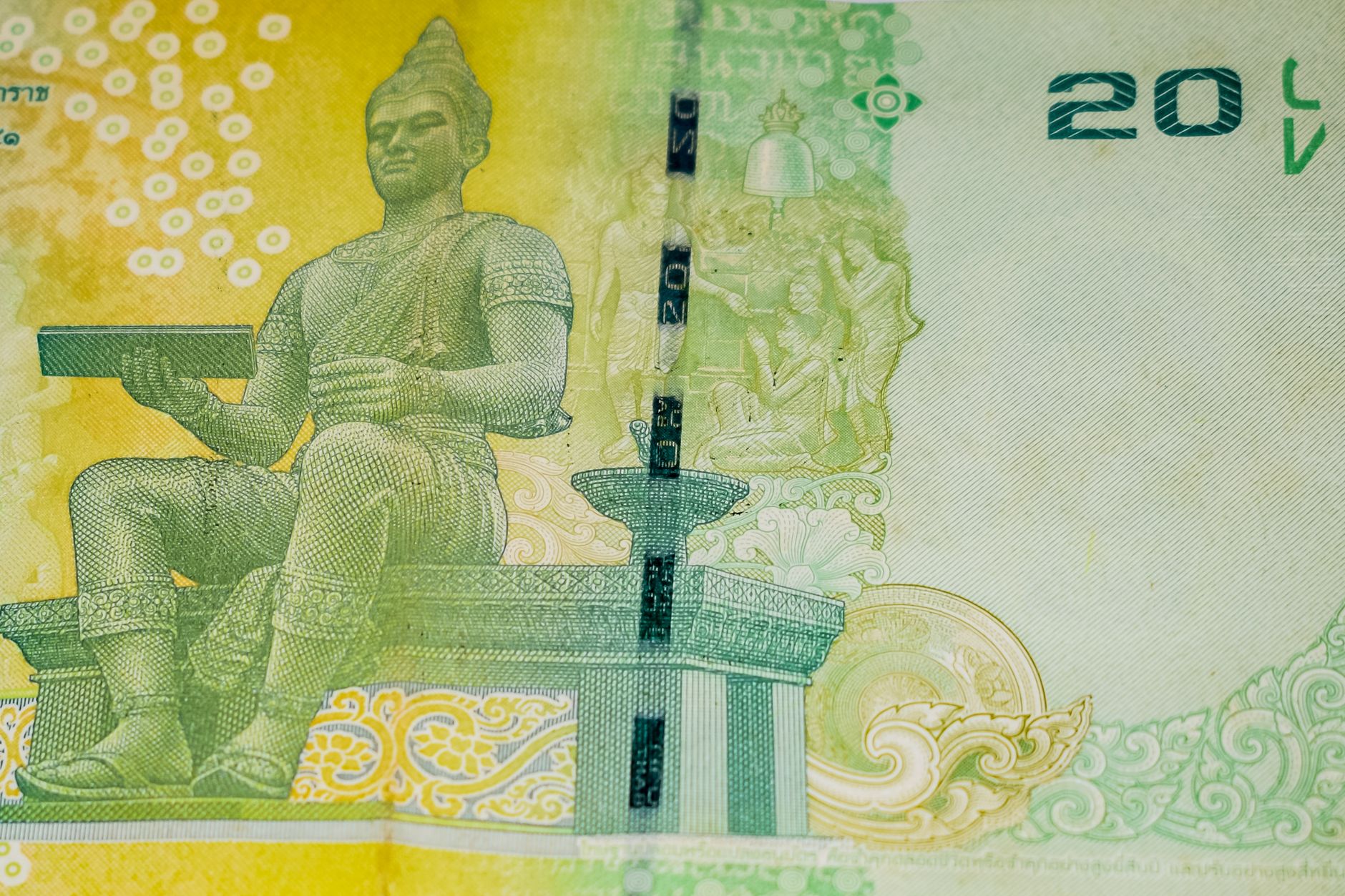 Thai banknotes fanned out next to a card reader at a market stall
The 7 things you need to know before your first taxi ride, with real fees on 4 different ways to move money.
Cash still runs about 60% of what tourists actually buy
Bangkok is more card-friendly than it was five years ago, and considerably more cash-dependent than tourists expect. Malls, chain restaurants, mid-range hotels, BTS ticket machines that take cards, 7-Eleven and Family Mart all take Visa and Mastercard without fuss. Street food, market stalls, songthaews, small guesthouses, motorbike taxis, metered taxis, temples, most massage shops, most tuk-tuks and about half of independent restaurants take only cash. Plan for a wallet with about $30-50 in small notes at all times.
The right mix for a week's trip: land with about $50-80 in local currency (get it at the ATM in arrivals, not the currency exchange), reload every three days at a bank ATM in town, and use a card for hotels, malls, sit-down restaurants and larger supermarket runs. Do not try to run cash-only, and do not try to run card-only. Both will leave you stuck at the third dinner or the first market.
ATMs charge $6-7 per withdrawal, so pull larger amounts
Every Thai bank ATM charges a foreign card fee of 220 baht (about $6.50) on top of whatever your home bank charges, and this fee applies whether you withdraw $30 or $300. The move is to withdraw the maximum your card allows in one go — usually $600-900 depending on your bank and the ATM — rather than making three separate $200 pulls and paying the fee three times. Bangkok Bank, Kasikorn (green) and SCB (purple) ATMs are the reliable ones; airport ATMs work fine but the fee is the same.
Two ATMs waive the foreign fee as of 2026: AEON (yellow, found in Big C supermarkets and some malls) and Citibank (rare, mostly in the CBD). AEON is the honest tip — the interior of Big C Ratchadamri, Big C Rajdamri and most Central branches have them, and you save $6.50 per withdrawal. Your home bank fee still applies. A card like Wise, Revolut or Chase Sapphire that rebates foreign ATM fees pays for itself in a week here.
The DCC trap: always choose to be charged in baht
Dynamic Currency Conversion is the single most expensive avoidable mistake in Bangkok, and every ATM and card terminal in the country tries it on. The screen will ask 'would you like to be charged in USD/GBP/EUR or in THB' and the honest answer is always THB. Choosing your home currency lets the local bank set the exchange rate, and it will be 4-8% worse than what your card issuer would give you. On a $200 dinner or a $500 ATM pull, that is real money.
The rule: whenever a card machine offers you a choice of currency, choose the local one. Whenever an ATM offers a 'guaranteed rate' or an 'exchange rate before you continue' screen, decline it. Your card issuer's Visa/Mastercard network rate is almost always better than the merchant's DCC rate, and the DCC prompt exists precisely because it profits the merchant, not you. This is true in Bangkok, in Chiang Mai, in Phuket, and honestly everywhere.
Exchanging cash: SuperRich, not the airport
If you arrive with US dollars, euros, pounds, Singapore dollars or Australian dollars in cash, do not exchange them at the airport counters — the rates there are 3-5% worse than in town. Take a taxi or the Airport Rail Link into the city, find a SuperRich (green branding, orange branding — both are legitimate competing chains) at Ratchadamri, Chidlom, Silom or Pratunam, and exchange there. Rates are within 0.5% of the mid-market rate and better than any bank counter.
Bring clean, unmarked, recent-issue notes. Thai exchange counters reject torn, written-on, or pre-2013 US notes without hesitation, and you will walk out with the same bills you walked in with. Larger denominations get better rates than smaller ones — a $100 bill exchanges at a slightly better rate than five $20s. Bring your passport, because exchanges over about $600 equivalent require it and the counter will ask.
Contactless, mobile wallets, and what actually taps
Contactless card payments work at most chain retailers, 7-Eleven, Family Mart, Starbucks, malls and supermarkets, and the tap limit is generous — usually up to $50 without a PIN. Apple Pay and Google Pay work wherever contactless works, which is genuinely convenient for the daily 7-Eleven water-and-snacks run. The BTS and MRT do not yet accept contactless bank cards at the gate as of early 2026, despite trials — you still need the Rabbit Card or MRT token.
Thailand's local mobile wallet is PromptPay, and it runs on a QR code system that ties to a Thai bank account. Tourists cannot easily open one without a Thai ID or long-stay visa, so you will see QR codes at market stalls that you cannot use. This is fine — those stalls also take cash. Do not try to sign up for a Thai bank account for a two-week trip; the paperwork exceeds the value of the convenience. Grab, Bolt and Foodpanda in-app payments handle most of the digital gap.
The scams that target your card and cash
The two card scams that actually happen in Bangkok: the double-swipe at low-end restaurants and bars where the terminal is 'not working' and needs a second try (it worked the first time — you now have two charges), and the tuk-tuk driver who takes you to a 'special government export shop' that charges $400 on your card for costume jewellery. Both are avoidable by watching every card transaction and never letting your card leave your sight in a restaurant. Ask them to bring the machine to the table, which is standard.
The cash scams: the taxi driver who claims your $10 bill is a $1 bill and hands back change on the lower number, and the market vendor who swaps your $20 for a torn or foreign note and asks for a replacement. Count out payment slowly, say the number out loud, and take a photograph of the taxi meter at the end of the trip if anything feels off. Grab and Bolt sidestep the taxi version entirely because the fare is charged to your card in-app.
A realistic daily cash budget
For a mid-range visitor, budget about $30-50 a day in cash on top of card-paid hotels and bigger restaurant meals. That covers: two street-food or casual meals ($6-10), transport within the city ($5-8 in BTS, MRT and short Grab hops), coffee and drinks ($5), one temple entry or attraction ($5-10), and a $10-15 buffer for market snacks, tips, and the songthaew you did not plan to take. Budget travellers can run this on $20 a day; luxury travellers barely need cash at all after airport taxi and temple entries.
Keep cash in two places. Day-money — one day's spending in $10-20 notes plus small change — goes in your front pocket or accessible wallet. Reserve — the rest of the week's cash and one backup card — stays in your hotel safe or a money belt at the bottom of your bag. If a pickpocket gets your day-wallet at Chatuchak, you lose $40 and an afternoon, not your trip. Never carry your passport around unless you are exchanging money or checking into a hotel; a photo on your phone is enough for everything else.
Before you book
What people ask before booking Bangkok.
Yes, any card on the Visa, Mastercard, Cirrus or Plus networks works at Thai bank ATMs. You will pay the local 220 baht ($6.50) foreign card fee plus whatever your home bank charges. Withdraw large amounts less often to minimise the per-transaction fee, and always choose to be charged in Thai baht rather than your home currency.
Most modern cards no longer require a travel notification, but it takes two minutes in-app and prevents the one bad afternoon where your card gets blocked on the third transaction. Also check your daily ATM withdrawal limit — the default $300 on some US cards is painfully low when withdrawals cost $6.50 each.
Withdrawing from a Thai ATM with a fee-free card (Wise, Revolut, Charles Schwab, Chase Sapphire) is cheapest. Withdrawing with a standard card is roughly equivalent to exchanging cash at SuperRich. Exchanging cash at the airport or at hotels is the worst option — you lose 3-5% to the spread.
No. Fewer and fewer banks in Bangkok will cash them, the queues are long, and the rates are worse than ATM withdrawal. Bring a debit card, a backup credit card, and about $100-200 in clean US dollars as emergency cash. That combination handles every payment scenario the city throws at you.