Ayutthaya or Bangkok: which to book for the ruins
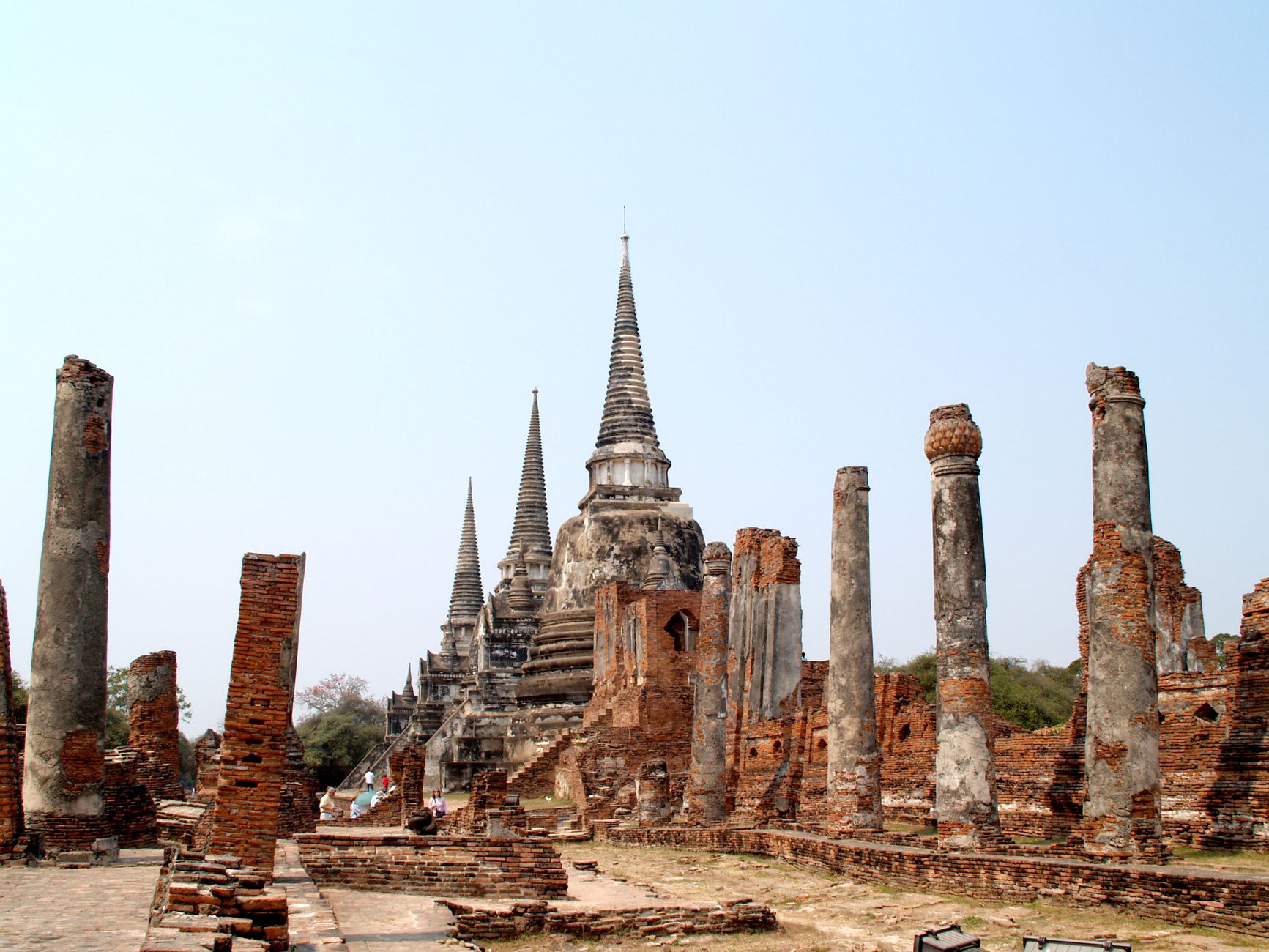 Ruined chedis of Wat Phra Si Sanphet at sunset in Ayutthaya
Ayutthaya is 80 km north of Bangkok, rooms cost 40-50% less, and the ruins are a five-minute cycle from most guesthouses — here is when to base yourself here rather than day-trip.
The one-line pitch
Ayutthaya was the Siamese capital from 1350 to 1767 and its ruined temples — Wat Mahathat with the Buddha head cradled in tree roots, Wat Phra Si Sanphet with three great chedis, Wat Chaiwatthanaram on the river — are the reason most travellers put it on the map. The historic centre sits on an island in the Chao Phraya about 80 km north of Bangkok, 90 minutes by train and $1.50 in third class. The hotel scene is small but complete: riverside boutique guesthouses on the east and north banks, mid-range chain hotels in the newer town, and a growing crop of design-led places along the river opposite Wat Chaiwatthanaram.
The pitch is that you sleep next to a UNESCO World Heritage Site for the price of a Bangkok hostel dorm. Rates run $12-25 for a fan-cooled guesthouse room, $30-55 for a decent air-conditioned boutique, and $80-160 for the small handful of upmarket riverside places. If your Ayutthaya visit is more than a rushed six hours, sleeping here beats sleeping in Bangkok.
Who should book here
Anyone who wants to see the ruins at dawn or after dark. The single strongest argument for basing yourself in Ayutthaya rather than day-tripping is time-of-day access. Day-trippers arrive at 10am when the sun is already brutal and leave at 4pm before the light softens. If you sleep here you cycle to Wat Mahathat at 6.30am with the site to yourself, and you watch the sunset from the river opposite Wat Chaiwatthanaram at 6pm. The ruins are photogenic all day but they are transcendent in the first and last hour, and only overnight visitors get that.
Slow travellers, cyclists and history-focused visitors should also stay at least one night. The historic island is easily bikeable — most guesthouses rent bicycles for $2 a day — and there is comfortably two full days of sightseeing before repetition sets in. Anyone continuing north to Sukhothai, Chiang Mai or Nan should also treat Ayutthaya as a natural first stop rather than doubling back to Bangkok.
Who should skip it
Anyone on a very short Thailand trip. If you are in the country for a week and Bangkok is the base, one long day trip to Ayutthaya is enough — take the 6.40am train, see the four or five essential temples, and be back for dinner. The overnight only justifies itself if you can spare two nights and want to genuinely explore rather than sprint. First-timers on tight schedules should day-trip.
Nightlife tourists and shoppers should also stay in Bangkok. Ayutthaya has a night market next to the ruins on weekends and a handful of good riverside bars, but nothing that resembles a bar scene, no rooftop cocktails, no late-night food street of any real depth. The town gets quiet by 10pm on weekdays. Families with small children need to plan for heat — the ruins offer little shade and midday can be punishing. Bring hats, water and plan around a long lunch break.
What a night actually costs
Backpacker guesthouses in the Naresuan Road area and along Chao Phrom run $10-22 for a fan room and $16-30 for air-conditioning. Mid-range boutique guesthouses on the river or in restored shophouses in the historic centre sit at $28-55. A handful of design-led properties along the river opposite Wat Chaiwatthanaram and along the northern bank run $70-140. Chain hotels in the new town (across the river to the east) — Classic Kameo, Ayutthaya Grand, similar — sit at $45-90.
Compared to central Bangkok, that is roughly 40-50% cheaper for equivalent quality in the mid-range and about the same at the top end. The furniture and finish at a $50 Ayutthaya boutique is generally on par with a $90 Bangkok Sukhumvit three-star; what you lose is 24-hour reception depth, English fluency at the front desk, and the range of restaurant delivery apps. What you gain is a bike, a river view, and a temple ten minutes down the road.
What is within cycling distance
From a guesthouse in the historic centre — anywhere on the island itself — you cycle to Wat Mahathat, Wat Ratchaburana, Wat Phra Si Sanphet, Viharn Phra Mongkhon Bophit, the elephant kraal, the Chao Sam Phraya National Museum and the Ayutthaya Historical Study Centre in 5-15 minutes each. Wat Chaiwatthanaram is on the west bank across the river, about 15 minutes on foot from the closest bridge. Wat Yai Chai Mongkhon and Wat Phanan Choeng are to the southeast, 15 minutes by bike or a $2 tuk-tuk.
The night market at Chao Phrom (weekend only), the daytime market at Hua Ro, the riverside restaurants along U-Thong Road, and the small strip of bars near Naresuan Road are all within a 10-minute cycle. What you cannot do easily from an island guesthouse: reach Bang Pa-In Palace, 20 km south, without organised transport or a taxi. Most guesthouses offer bike hire, longtail river tours ($10-20 for two hours) and van transfers to Bang Pa-In ($15-25).
Ayutthaya versus a Bangkok day trip
The day-trip case: 6.40am third-class train from Hua Lamphong (Bang Sue Grand from 2026), arrive Ayutthaya 8.30am, rent a bike or hire a tuk-tuk for the day ($20-30), see four to six temples, eat lunch on the river, catch the 4pm or 5pm train back, home by 7pm. Total cost around $35-50 per person including entry fees. This works for one solid day of highlights and it is genuinely satisfying if the schedule is tight.
The overnight case: same journey up, arrive 8.30am, check into a $40 guesthouse by 11am, cycle at your own pace, see the ruins at dawn and dusk, eat dinner by the river, cycle the following morning to Wat Chaiwatthanaram at 6.30am for the light, catch the afternoon train back. Total cost around $90-130 per person for two days. The extra $50 buys you the two best hours of light in the historic complex, and for many travellers that alone is the trip.
Getting in and out
From Bangkok: cheapest is the third-class train from Bang Sue Grand Station or Hua Lamphong (services are being progressively moved to Bang Sue), 90-120 minutes and $0.60-1.50 depending on class. Air-conditioned second-class runs 90 minutes and $3-5. Minivans from Mo Chit 2 or Victory Monument take 75-90 minutes and cost $2-3. A private taxi runs $35-55 and 60-90 minutes. The train is the honest answer — it is cheap, reliable, and the view crossing the rice paddies is the best part.
Onward from Ayutthaya: continuing north to Sukhothai (5 hours by train or bus, $8-15), Chiang Mai (10-13 hours by train or overnight sleeper, $15-45), or Nong Khai for the Laos border (8-10 hours by train). Ayutthaya's station sits on the east bank across the river from the historic centre — a $1 ferry hop or a $3 tuk-tuk. Give yourself 20 minutes for the crossing before any train departure.
Before you book
What people ask before booking Ayutthaya.
One long day covers the four or five essential ruins as a Bangkok day-trip. Two days lets you also see sunset over Wat Chaiwatthanaram, dawn at Wat Mahathat, and the outlying temples like Wat Yai Chai Mongkhon and Wat Phanan Choeng at a proper pace. Three days is genuinely too many unless you are combining it with Bang Pa-In and a river cruise.
The historic centre is 4 km wide and 3 km deep — walkable in theory but punishing in the heat. Rent a bike from your guesthouse ($2-3 a day) or hire a tuk-tuk driver for the day ($20-30) if you prefer not to cycle. Motorbike rental is also available at $6-10 a day and is the fastest option if you are confident riding in Thai traffic.
Yes, and it is a good use of the train network. Take the morning train from Bangkok to Ayutthaya, spend one or two nights, then board a northbound train onward to Chiang Mai. The overnight sleeper from Bangkok passes through Ayutthaya around 8pm; you can join it there rather than starting from Bangkok. Book the sleeper seat in advance in high season.