Tipping and etiquette in Bangkok: what actually matters
 Hands performing a wai greeting in front of a temple
The 8 rules that separate a respectful visitor from an oblivious one, with real numbers for what to leave and where.
Tipping is optional but expected in specific places
Thailand is not a tipping culture the way the US is, but it is also not a no-tip culture like Japan, and pretending either extreme applies will get you into trouble. Mid-range and upscale restaurants add a 10% service charge automatically — look at the bottom of the bill for 'service charge' — and that is the tip. You do not add another 10% on top. If there is no service charge and the meal was good, rounding up or leaving $1-3 in cash is generous and appreciated.
Street food and casual noodle shops do not expect a tip and can be mildly confused by one. Hotel porters get $1 per bag, housekeeping gets $1-2 per day left on the pillow, spa therapists get $3-5 for a good hour-long massage, and Grab drivers get nothing beyond the fare unless they helped with luggage, in which case $1 in cash. Metered taxi drivers round up to the nearest $0.30; nobody expects more than that.
Feet, heads, and why they matter
The single quickest way to offend someone in Thailand is with your feet: do not point them at people, at Buddha images, or at photographs of the royal family. This sounds abstract until you are sitting cross-legged on a temple floor with your soles aimed at the main altar and a monk gestures at you to fold them under. Tuck your feet behind you when sitting on the ground, do not put them on chairs or tables, and never step over someone lying on the floor — walk around.
The head is the opposite: it is the most sacred part of the body, and touching an adult's head, even affectionately, is deeply rude. Do not ruffle a child's hair even if they are cute. Do not pat a monk. When passing something to someone older or more senior, use two hands or your right hand with your left touching your right elbow — this is the standard polite gesture and locals will notice you doing it correctly.
The wai: when to do it, when not to
The wai — palms pressed together, slight bow — is the Thai greeting, and tourists overuse it in ways that make locals slightly uncomfortable. You do not wai children, hotel staff who wai you first as part of their job, cashiers, waiters, or Grab drivers. Returning a wai from staff with a nod and a smile is the correct response. Waiing back at full ceremony from a customer to a bellhop scrambles the social hierarchy the gesture is built around.
When you should wai: meeting someone's parents or an older person you are being introduced to, greeting a monk (they do not wai back — do not be offended), and thanking someone who has done you a genuine personal favour. The height matters: fingertips at chest level for peers, at nose level for elders, at the eyebrows for monks and royalty. Get it approximately right and no one will mind that it is not perfect.
Temples: dress code is actually enforced
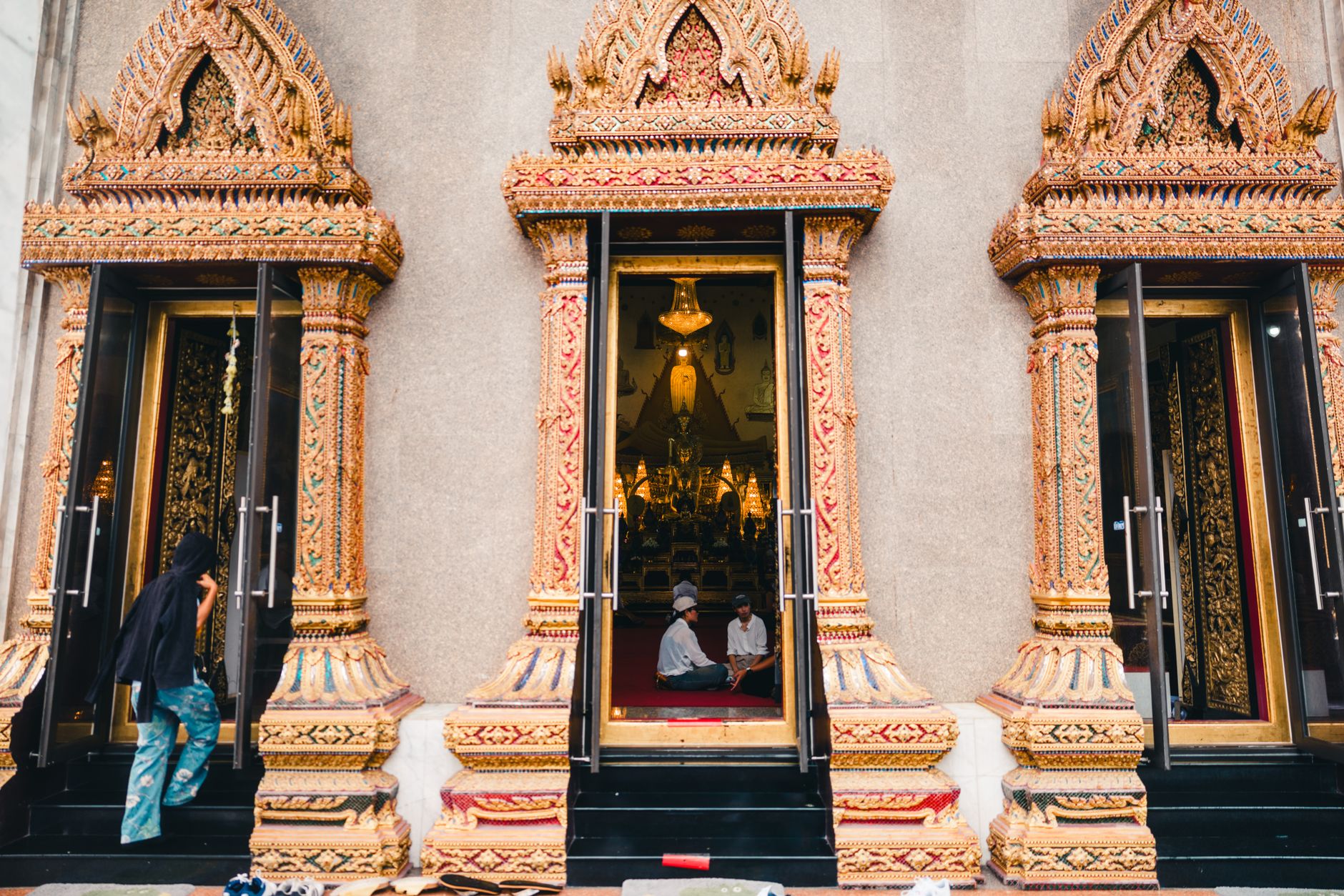
Wat Pho, Wat Arun and the Grand Palace enforce dress codes at the entrance, and the guards will turn you away or make you rent a sarong for $5 with a $10 deposit. Shoulders covered, no vest tops, no strappy dresses. Knees covered, no shorts, no short skirts. Ankles are fine, feet are fine (shoes come off inside), stomachs must be covered. Leggings under a short dress do not count as covered legs at the Grand Palace, which is the strictest of the three.
Inside temples: shoes off before entering any building, hats off, sunglasses off. Do not point at Buddha images, do not climb on them for photographs, and do not turn your back on the main altar to take a selfie with the Buddha behind you. Women must not touch monks or hand things to monks directly — put the item on a cloth or table for the monk to pick up. Speaking normally is fine; loud voices are not.
The royal family: not a joke topic
Thailand has strict lèse-majesté laws, and the king, queen and immediate royal family are not subjects for humour, criticism or casual conversation with strangers. This is not folk custom, it is criminal law with prison sentences attached, and foreigners have been prosecuted. Do not step on banknotes or coins (the king's image is on them). Stand up at 8am and 6pm in public parks and BTS stations when the national anthem plays — everyone stops moving, and standing is the minimum expected of visitors.
Cinemas play a short royal anthem before every film with footage of the king; the audience stands. Portraits of the king hang in almost every business and public building, and photographing them disrespectfully — flippant selfies, mock salutes — is a genuinely bad idea. None of this requires you to have opinions about the monarchy. It just requires you not to voice them out loud, in Thai or English, in a country that takes them very seriously.
Volume, temper, and losing face
Raising your voice in Thailand almost never gets you what you want, and it will usually get you the opposite. Losing your temper in public — at a taxi driver, a hotel receptionist, a shop clerk — makes you the one who has lost face, not them, and the room will side with the calm local over the shouting foreigner every time. If something has gone wrong, smile, speak quietly, and ask again. This works. Shouting does not.
The corollary: a smile in Thailand is not always a smile of pleasure. It can mean 'I am embarrassed', 'I do not understand', 'I am sorry', or 'please stop being upset'. Reading a nervous smile as agreement or as mockery is a classic misfire. The rule that gets you through nearly every interaction: match the register of the person in front of you, keep your voice down, and treat 'mai pen rai' (never mind, no worries) as a genuine cultural value rather than a slogan.
Bargaining: yes at markets, no at 7-Eleven
Bargain at Chatuchak, at Khao San's stalls, at tourist markets, at street stalls selling clothes and souvenirs, and with tuk-tuk drivers. Do not bargain at 7-Eleven, at restaurants with menus, at supermarkets, at malls, at pharmacies, or at any place with a printed price tag. The line is clearer than tourists assume: printed price means fixed price, spoken price means negotiable.
The mechanics: ask the price, counter with 50-60% of it, meet in the middle. Smile throughout. Walking away is a legitimate move and will often bring the seller after you with a better number, but do not walk away as a bluff on something you actually want — you might not get the offer back. If you agree a price, you buy. Backing out after a handshake is genuinely rude. And do not bargain hard over 30 baht (about $1) — the pride of winning is not worth what it costs the seller.
The small things that make locals like you
Take your shoes off when entering a Thai home, a guesthouse living area, some shops (look for the pile of shoes at the door), and every temple building. Say 'sawasdee krap' (men) or 'sawasdee ka' (women) when entering a small business, and 'khop khun krap/ka' when leaving. Add 'krap' or 'ka' to the end of any sentence you speak in Thai — it is the politeness particle and its absence sounds curt.
Do not photograph people, especially monks and market vendors, without a smile-and-gesture ask first — most will say yes, and the ask matters more than the answer. Do not haggle a food vendor down over 10 baht. Do not clink glasses hard and shout 'cheers' in a quiet restaurant. Do carry small notes ($1-3 bills) for tips, small purchases and songthaews — nobody wants to break a $30 bill for a $1 sale, and being the person with exact change makes you popular fast.
Before you book
What people ask before booking Khao San.
Round up metered taxis to the nearest $0.30 or so. For Grab, no tip is expected because the fare is set in-app, but adding $1 through the app's tip function for a helpful driver — one who loaded bags, took a suggested shortcut, or waited — is appreciated and not weird.
No, a smile and a slight nod is the correct response. Staff wai guests as part of their job, and returning a full wai reverses the hierarchy the gesture encodes. Save the wai for older people you are introduced to, monks, and moments of genuine personal gratitude.
Not particularly. Thai meals are ordered family-style with several shared dishes, and leaving a small amount is normal. What is mildly rude is ordering more than you can eat at a small vendor and then dumping most of it, or refusing to try something a host has specifically made for you. Take a bite, smile, thank them.
Absolutely, and locals do. The dress code is temple-specific and government-building-specific. On the BTS, in malls, in restaurants, at markets and on the street, shorts and t-shirts are entirely normal in the heat. Just carry a light scarf or long trousers in a bag if a temple visit is in your day's plan.