Getting around Bangkok
Bangkok traffic is the punchline of Southeast Asian travel, but the city also has 2 subway lines, 2 elevated train lines, an airport express, and a river boat network. Use the rails, avoid the roads, and 30-minute crossings become 15.
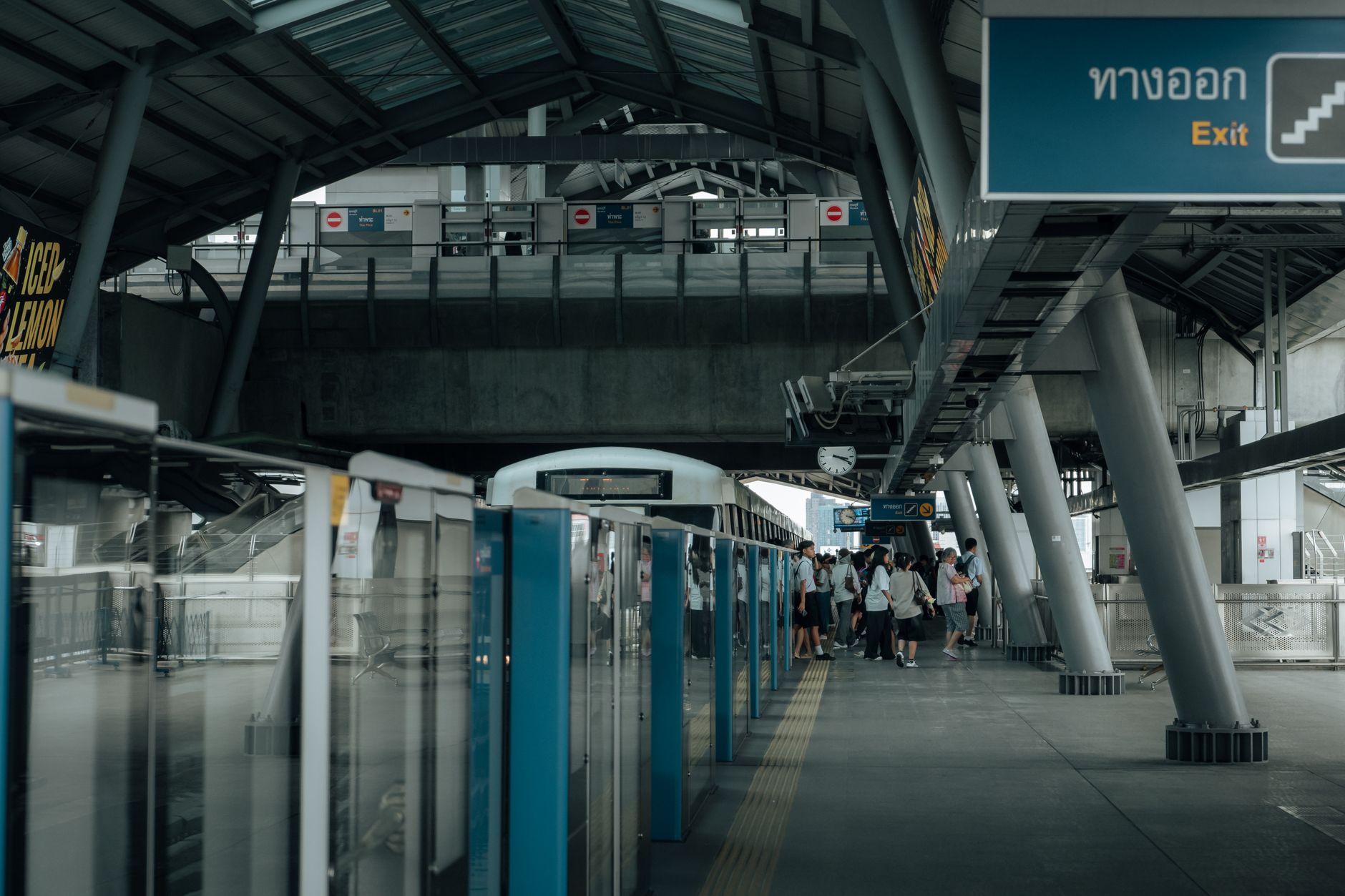 BTS Skytrain arriving at an elevated Bangkok station
The BTS Skytrain and MRT subway
The BTS has 2 lines — Sukhumvit (light green) running from Kheha in the far east through central Bangkok to Khu Khot in the north, and Silom (dark green) crossing from National Stadium to Bang Wa across the river. They meet at Siam. Single fares run $0.50 to $1.90 based on distance, and a Rabbit card ($5 for the card, $5 minimum load) skips the queues. Trains run every 3 to 5 minutes from 6am to midnight.
The MRT Blue Line is a full subway with an interchange to the BTS at Asok/Sukhumvit, Sala Daeng/Silom, and Mo Chit/Chatuchak Park. It reaches Chinatown (Wat Mangkon), the Old Town (Sanam Chai for Wat Pho), and Hua Lamphong old train station. Fares are $0.50 to $1.30. The MRT card is separate from the Rabbit card, which is annoying, but each system takes contactless credit cards at most gates now.
Taxis, Grab, and Bolt
Pink and green metered taxis are cheap — $2 to $5 for most cross-town rides — but flagging one that agrees to use the meter can be a hassle at tourist sites. Refuse any driver who quotes a flat rate; walk 30 meters and flag another. In-app services solve this. Grab is the dominant app, with GrabTaxi (metered) and GrabCar (private) options. Bolt is often 20 percent cheaper for the same route. Both take card payment and show the price upfront.
Traffic between 4pm and 7pm on weekdays is genuinely terrible — a 5 km ride can take 45 minutes. Plan to be on the BTS or MRT during those hours and save taxis for late night or off-peak. Motorbike taxis (drivers wear orange vests) queue at every major intersection and soi entrance; $1 to $3 gets you a mile through gridlock. They are safe enough at low speeds but strap your bag in front, not on your back.
River and canal boats
The Chao Phraya Express Boat runs from Sathorn (Saphan Taksin BTS) north to Nonthaburi, stopping at all the major riverside sights. Orange flag boats are the local commuter service at $0.50 flat fare. Blue flag tourist boats charge $5 for a hop-on-hop-off day pass with English announcements — worth it if you plan to visit Wat Arun, Wat Pho, and the flower market in one day. Boats run roughly every 15 minutes from 6am to 7pm.
The Khlong Saen Saep canal boat is the fastest way from Sukhumvit to the Old Town — 25 minutes flat, no traffic, $0.30 to $0.60 depending on distance. Board at Asok Pier (behind The Robinsons at Asok BTS) or Pratunam. It is loud, splashy, and diesel-scented, and you climb on and off moving boats — locals stretch a plastic sheet to block spray. Not for the faint-hearted but genuinely useful.
The Airport Rail Link
Suvarnabhumi Airport (BKK) connects to central Bangkok via the Airport Rail Link, which terminates at Phaya Thai (BTS interchange). Fare is $1.30, trip is 30 minutes, trains every 15 minutes from 5:30am to midnight. From Phaya Thai you switch to the BTS Sukhumvit line to reach most hotels. Total time from arrivals to a Sukhumvit hotel is about 60 minutes including walking.
Don Mueang Airport (DMK), the second airport used by budget airlines like AirAsia and Nok, has no rail link. Options are the SRT Dark Red Line commuter train to Krung Thep Aphiwat (formerly Bang Sue) then MRT — $1.20 total but slow — or the A1 bus to Mo Chit BTS for $0.90. Taxis from Don Mueang to Sukhumvit run $10 to $15 with tolls; from Suvarnabhumi, $12 to $18. Uber-style apps often beat metered airport taxis after the $2 airport surcharge.
Buses, tuk-tuks, and walking
Bangkok has an extensive public bus network with fares from $0.20 to $0.75, but routes are complicated, English signage is minimal, and buses share the same traffic as taxis. Skip unless you are staying more than 2 weeks. Tuk-tuks are the touristic option — negotiate hard, expect $3 to $6 for anything under 3 km, and never accept the $1 sightseeing tour that ends at a gem shop. Ride one once for the experience, then use apps.
Walking is underrated in some neighborhoods (Old Town, Chinatown at night, the sois between Nana and Ekkamai) and awful in others (Silom at rush hour, anywhere along Rama IV). Sidewalks are uneven, motorbikes ride on them, and vendor stalls block them. Google Maps walking times in Bangkok are optimistic by 20 to 30 percent. Bring water and check for shade routes — a walk on the wrong side of Sukhumvit in April is genuinely rough.
A practical daily strategy
Base your day around the BTS or MRT. Load $10 onto a Rabbit card, another $10 onto an MRT card, and open Grab. Plan your route so that hotel-to-first-stop and last-stop-to-hotel run on rails; use Grab or a taxi only for the middle links off the network. That single principle turns a chaotic city into a manageable one. If your hotel is more than 700 meters from a station, motorbike taxis at the mouth of your soi get you to the platform for a dollar.
Buy a Thai SIM at the airport (AIS or True are the main networks, $10 for 15GB and unlimited data on TikTok/Facebook). Google Maps is accurate for BTS/MRT times but not for buses. The MRT app and BTS SkyTrain app both show real-time schedules. Screenshot your hotel's Thai-language name and address to show to drivers who do not read Latin script — most in Bangkok do, but the older taxi drivers may not.
Frequently asked questions
What people ask before they set off on this one.
Get the Rabbit card if you are staying 3 days or more and plan to use the BTS 3 or more times a day. It is $5 for the card plus your top-up, and it skips ticket-machine queues that get long at Asok, Siam, and Nana. For a 2-day stopover, single tickets or contactless credit card taps at the gate are fine. Note that Rabbit and MRT cards are separate systems.
By meter with the $2 airport surcharge and highway tolls, expect $12 to $18 to a central Bangkok hotel. Refuse any fixed-price offer at arrivals — they run $25 to $35. Use the official taxi queue on Level 1, tell the coordinator your destination, they print a slip, and you pay the meter to the driver plus tolls in cash. Grab and Bolt often quote $14 to $20 with no negotiation needed.
Once, for 15 minutes, at night when traffic has cleared. Do not use tuk-tuks for airport transfers, long crossings, or anything where you are being told a bargain fare — those almost always involve gem shop or tailor stops. Fair price is roughly the metered taxi fare plus 30 percent. Agree the price before getting in, and confirm the destination on Google Maps in front of the driver.
There is a free airport shuttle bus for passengers with confirmed onward flights — show your boarding pass. It runs every 30 minutes and takes about 60 minutes in normal traffic, 90 in rush hour. Alternatively a taxi runs $15 to $22 including tolls and takes 40 minutes off-peak. Allow at least 4 hours between flights; 3 is possible but risky.
Safe enough for daily use by tens of thousands of commuters, but they are basic. You board and exit while the boat is still moving slowly and touching the pier. Hold the rope, watch your step, and keep valuables in a zipped bag. The water splashes over the sides and is not clean — the plastic sheeting that passengers pull up is for a reason. Skip if you have limited mobility.
Hotels in Bangkok
More guides to Bangkok
All guides Itineraries · 8 min read
48 hours in Bangkok
Itineraries · 8 min read
48 hours in Bangkok
Two days is enough to nail the temples, one great market and a proper rooftop — if you sleep in the right neighborhood. This itinerary keeps transfers under 20 minutes and dinners under $15.
 Itineraries · 10 min read
One week in Bangkok
Itineraries · 10 min read
One week in Bangkok
Seven days is the sweet spot: temples, two day trips, real neighborhoods, and enough downtime to eat properly. Here's how we’d split a week if we were doing it again tomorrow, hotel by hotel.
 Itineraries · 8 min read
Bangkok in 3 days on a budget
Itineraries · 8 min read
Bangkok in 3 days on a budget
Three days in Bangkok on under $60 a day is genuinely doable — hostels at $12, meals under $3, and every temple within reach on public transport. Here's the honest plan.
Real photos, real prices, and one tonne of carbon removed with every booking — at the same rate you would pay anywhere else.